Does root killer work in a sewer line?
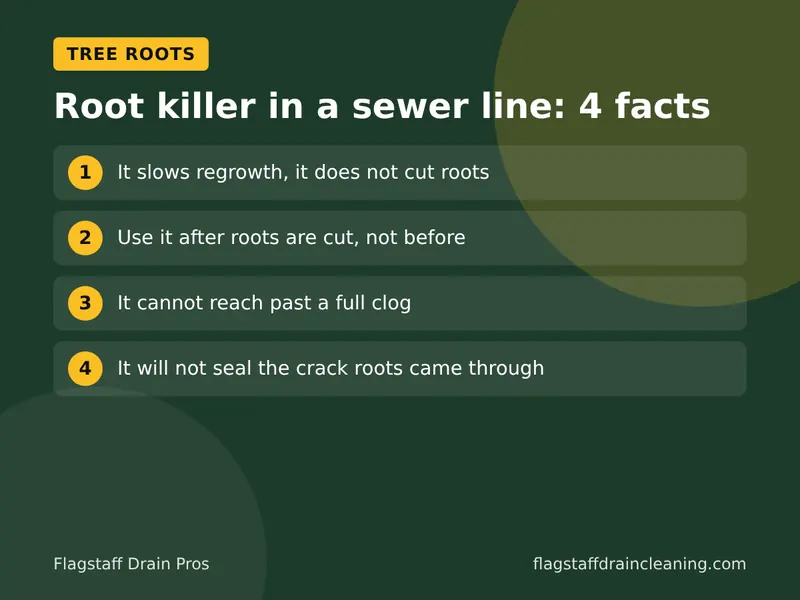
Root killer can help, but only as follow-up. Foaming products and copper sulfate kill the thin roots they touch and slow regrowth for months. They do not clear a clogged line, break up a root mass or fix the crack the roots came through. The best order is to cut the roots out first, then use a root treatment to slow them coming back.
Flagstaff yards are full of ponderosa pine, aspen and cottonwood, and their roots seek out the warm, wet air leaking from old sewer joints. If your toilet is already backing up, skip the store shelf and call drain cleaning Flagstaff AZ to open the line first.
How do sewer root killers work?
- Copper sulfate crystals. Flushed in small amounts, they kill roots they settle on. Much of it passes through the pipe quickly, so contact time is short.
- Foaming root killers. These expand to fill the pipe and coat the top and sides, where roots often enter. They are often made with an herbicide like dichlobenil and are usually more effective in the pipe.
- Neither one cuts roots. Dead roots still block the pipe until they rot or are removed.
When does root killer help?
- Right after mechanical root cutting, to slow the small regrowth at each joint.
- On a schedule, often every 6 to 12 months, as part of maintenance on a line you know has root entry.
- While you plan a repair, to stretch the time between cleanings.
Our guide on tree roots in the sewer line covers the signs to watch for. A slow toilet and gurgling tub are often the first clues.
When does it not help?
Root killer does not help when the line is already blocked, because the product cannot reach the roots past the clog. It also does not help with a collapsed pipe, a deep sag, or grease and wipes. And it will not seal the crack, so roots return as long as the joint leaks.
If a clogged kitchen sink is your only slow drain, roots are rarely the cause. Roots usually hit the main line, so several drains slow down together.
What safety rules should you follow?
- Read the label and the dose. More is not better and can harm septic systems.
- Do not use it on a septic tank system unless the label says it is safe. Homes in Doney Park and other areas on septic need special care.
- Never mix it with other drain chemicals. Wear gloves and eye protection.
- Do not pour it into sinks or tubs. Most products say to use the toilet closest to the main line or the cleanout.
The U.S. EPA explains that pesticide labels are legal instructions in its guide to reading pesticide labels. Root killers fall under those rules.
When should you call a pro?
Call if the main line is backing up, if you need root killer more than twice a year, or if you have never had the line looked at. Root cutting in Flagstaff runs about $350 to $900. A camera check shows where the roots get in, so you can decide between ongoing treatment and a repair.
If the camera finds cracked pipe, ask about lining. Our guide to trenchless sewer repair explains when it fits.
Frequently asked questions
Can I pour root killer down the toilet?
Many products are made to be flushed down the toilet closest to the main line. Follow the label dose exactly and do not use it if the line is already backed up.
Will copper sulfate damage my pipes?
Used as directed it is generally safe for clay and cast iron sewer lines, but some cities limit it because copper can harm waterways. Check the label and local rules.
How long does root killer last?
Most treatments slow regrowth for several months. Many homeowners repeat them every 6 to 12 months after the roots are cut.
Is root killer safe for septic systems?
Not always. Some products can harm the bacteria in a septic tank. Use only a product labeled safe for septic, or ask a pro first.