What does your sewer camera report actually say?
A sewer camera report tells you what is inside your sewer line and where. It names the pipe material, marks the distance to each problem from the cleanout, and rates how serious each one is. The most common findings are roots, a belly or sag, an offset joint, cracks, scale or grease buildup, and breaks. Some need only cleaning, while others need a repair.
Many Flagstaff homeowners get a camera inspection after a backup or before buying a house, then receive a video and a page of notes that use terms they have never heard. This guide translates those terms. If you have not had the line scoped yet, our sewer camera inspection in Flagstaff page explains how the visit works.
How do you read a sewer camera video?
Watch the footage counter in the corner. It shows how far the camera is from the starting point, usually the cleanout. Each problem in the report is tied to a distance, which tells a crew where to dig or where to focus cleaning. A clean pipe looks smooth and round, with water flowing along the bottom and joints that line up.
- Footage counter: the distance from the cleanout. A note like "roots at 42 ft" means 42 feet down the line.
- Pipe material: cast iron looks dark and rough, clay looks orange or tan with short sections, and PVC or ABS looks smooth white or black.
- Water level: a little water along the bottom is normal. Water that fills the pipe and the camera goes under points to a low spot.
- Joints: each joint should be a thin ring. A ledge or gap means an offset or separation.
What do the common findings mean?
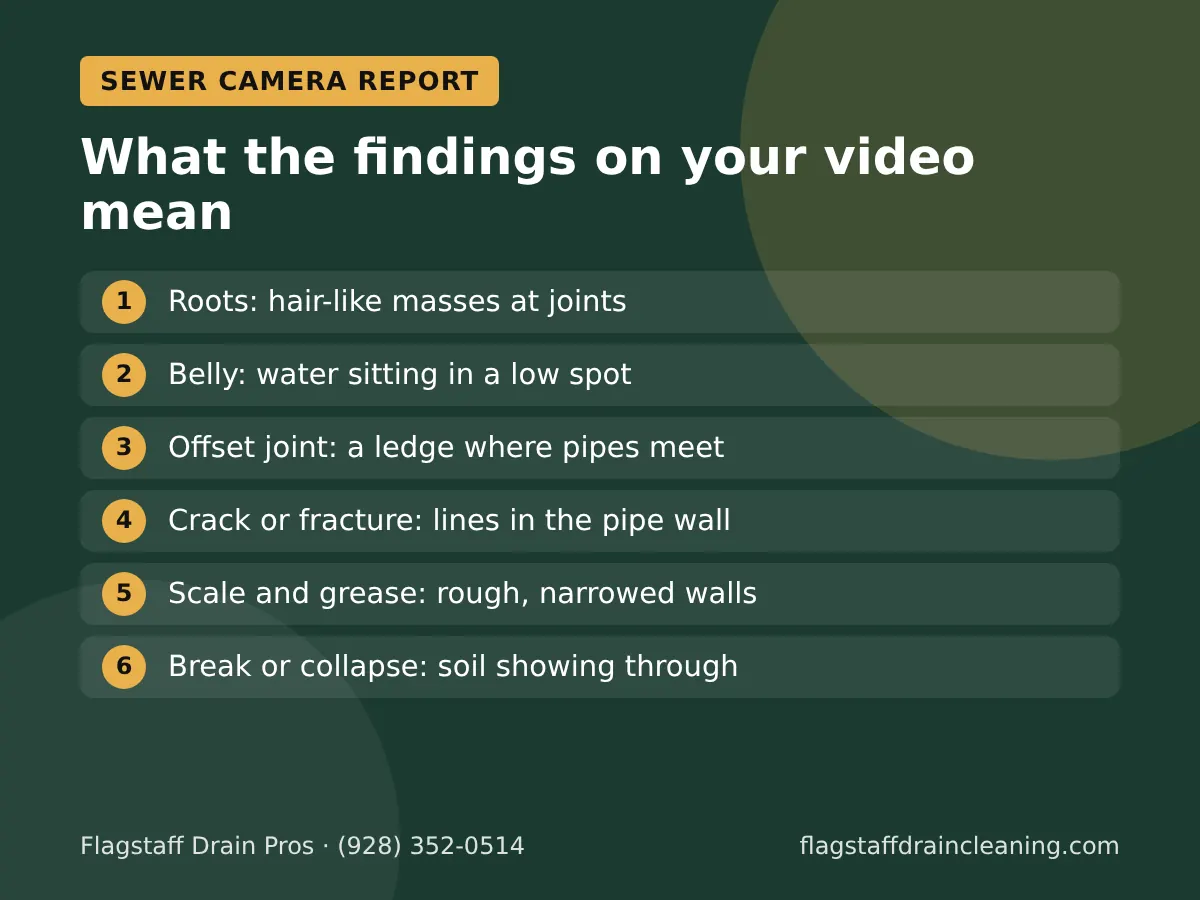
Each finding has a typical look and cause. Roots show as hair-like strands or thick mats at joints. A belly shows as standing water. An offset shows as a ledge where two pipes meet. Cracks show as dark lines. Scale and grease make the pipe look rough and narrow. A break or collapse shows soil or a hole.
| Finding | What it looks like | Common cause in Flagstaff |
|---|---|---|
| Roots | Hair-like strands or a mat at a joint | Pines, aspens and elms near clay joints |
| Belly or sag | Camera dips under standing water | Soil settling, freeze-thaw movement |
| Offset joint | A ledge where pipe ends meet | Ground shift, frost heave, roots |
| Crack or fracture | Dark lines along or around the pipe | Age, freezing, heavy loads above |
| Scale or tuberculation | Rough, bumpy walls, narrower pipe | Rusting cast iron in older homes |
| Grease buildup | Thick coating, often at the bottom | Kitchen grease and food waste |
| Break or collapse | A hole, missing section or soil inside | Old clay or Orangeburg pipe, roots, settling |
Which findings are urgent?
A break, collapse, or severe belly that stops flow is urgent, because sewage can back up into the house or leak into the soil. Heavy roots that block most of the pipe are next. Light roots, small offsets, minor scale and short shallow bellies can often wait, with regular cleaning, while you plan a repair.
- Fix now: breaks, collapses, missing pipe, sewage in the soil, full blockages.
- Plan soon: heavy roots, deep or long bellies, large offsets, cracks that are growing.
- Monitor: light roots after cleaning, small offsets, minor scale, short shallow bellies.
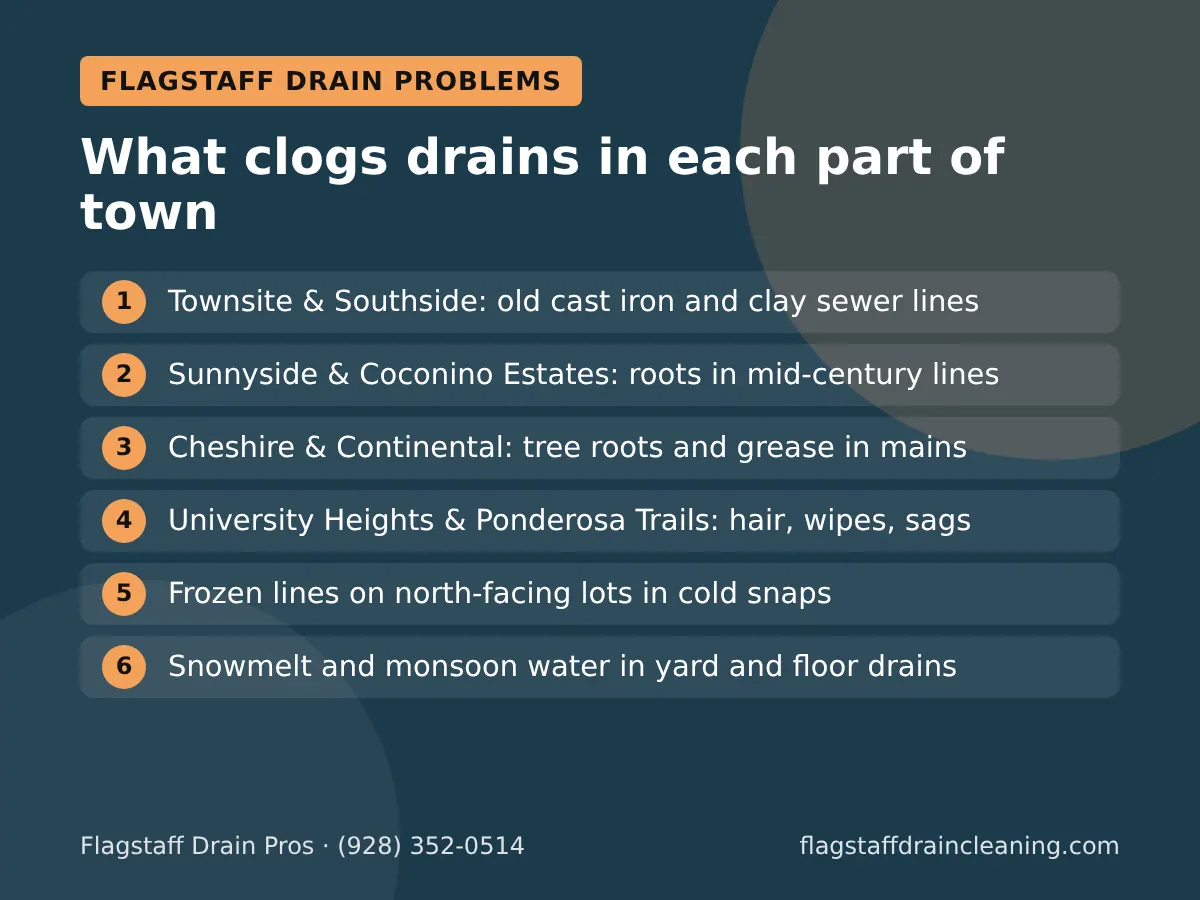
Winter makes a weak line worse in Flagstaff. Water held in a belly or behind roots can freeze on long cold nights, and frost heave can shift a pipe that is already offset.
How is each problem usually fixed?
Roots, grease and scale are usually cleaned out with a cable machine or hydro jetting. Bellies, breaks and big offsets usually need the bad section dug up and replaced, or a trenchless method like lining or pipe bursting where the pipe allows. A follow-up camera run after cleaning shows whether the line is sound.
- Roots: cut and clear, then consider lining or repairing the joint. Our tree root removal in Flagstaff page covers the options.
- Scale and grease: water jetting at the right pressure clears the walls. See our hydro jetting services page for when jetting is safe on older pipe.
- Belly: regular cleaning for small ones, a spot repair for large ones. Our guide to a sewer line belly or sagging pipe explains the choice.
- Cracks, breaks, collapses: a spot repair, lining or full replacement, depending on how much of the line is affected.
What should you ask after the inspection?
Ask for the video file, the written notes with footage marks, and the pipe material. Ask which findings are urgent, which can be watched, and what each fix would cost. If a repair is recommended, ask whether trenchless is an option and whether a second camera run is included after cleaning.
- Can I keep a copy of the video?
- Where exactly is each problem, and how deep is the pipe there?
- Does the line need cleaning first to see clearly?
- Is this a spot repair or a sign the whole line is failing?
- Is the problem on my side of the property line or the city's?
If you are deciding between a spot fix and a new line, our guide to repairing or replacing a sewer line walks through the trade-offs, and our post on trenchless sewer repair in Flagstaff covers lining and pipe bursting.
What does a camera inspection and the follow-up work cost?
A camera inspection in Flagstaff is about $200 to $450. Main line cleaning is about $250 to $550, hydro jetting about $450 to $1,000 and tree root removal about $350 to $900. Dig repairs and trenchless work are priced after the inspection, based on depth, length and access.
| Service | Approx. cost |
|---|---|
| Camera inspection | $200 – $450 |
| Main sewer line cleaning | $250 – $550 |
| Hydro jetting | $450 – $1,000 |
| Tree root removal | $350 – $900 |
For a closer look at what drives the inspection price, read our guide to sewer camera inspection cost. To book a camera run, cleaning or a second opinion on a report you already have, our team provides drain cleaning Flagstaff AZ homeowners can call 24/7 at (928) 352-0514.
Frequently asked questions
What does a sewer camera inspection show?
It shows the inside of your sewer line from the cleanout to the city main or septic tank: the pipe material, roots, grease and scale buildup, low spots that hold water, offset or separated joints, cracks, breaks and the distance to each problem. A good report includes the video, notes and the footage marks.
Is a belly in a sewer line serious?
It depends on the size. A short, shallow belly that holds a little water may only need regular cleaning. A long or deep belly that collects waste and causes repeat clogs usually needs that section dug up and re-laid at the right slope.
Can roots in a sewer line be fixed without digging?
Often, yes. Roots can be cut with a cable machine or cleared with hydro jetting, and some lines can be lined afterward to seal the joints. If the pipe is broken where roots got in, that spot may need a dig repair.
How often should I get my sewer line inspected?
Have it scoped when you buy a home, after any backup with an unknown cause, before a big remodel, and every few years in older homes with clay or cast iron pipe or big trees near the line.
How much does a sewer camera inspection cost in Flagstaff?
A camera inspection is about $200 to $450. Main sewer line cleaning is about $250 to $550, hydro jetting about $450 to $1,000 and tree root removal about $350 to $900. You get the price before work starts.